Advertisement
You Already Know How to Calm Down. So Why Does None of It Work at 3 a.m.?
You've read every list of anxiety tips. You could probably write one. Here's the part those lists leave out — and the one thing that actually works in the moment you need it.
Advertisement. Fermata Chime is made and sold by Fermata Wellbeing. This is one person's experience and general wellbeing information, not medical advice.
You know you should sleep more. Drink less coffee. Get outside. Move your body. Put your phone down an hour before bed. You know all of it — at this point you could probably write the article.
So why are you reading another one at 1 a.m.?
I'm not asking to be cute; it's the actual question, and almost no wellness piece is honest about the answer. For most people who feel wired and anxious, the problem was never a lack of information. You're not under-informed. You're over-informed and still lying awake — which means another list of tips, however good, isn't going to fix the thing. Somewhere, you already suspect that.
Why none of it has stuck
Here's the part those lists quietly get wrong: almost all of them are aimed at your mind. Think differently. Reframe the thought. Challenge the belief. Count your blessings. Which is a strange thing to ask of someone whose mind is the part that won't cooperate — a bit like asking the smoke alarm to put out the fire.
The more useful idea, and it's physiology rather than a vibe, is that the state comes first and the thoughts come second. You don't spiral because you're thinking anxious thoughts; your body tips into a stress state, and then your mind writes the story to match. Settle the body and the thoughts lose their fuel. Try to argue the thoughts down while your body is still in alarm and you'll lose, every time, because you're fighting on the wrong floor of the building.
So the real question isn't how do I think better. It's how do I get my body out of alarm — first on an ordinary day, and then in the exact moment it counts.
First, the boring stuff that genuinely works
None of this is new, and that's the point — it works precisely because it's unglamorous. If you do nothing else, do these. They lower the whole baseline, so the spikes get smaller and rarer.
Get light in your eyes early. Ten minutes outside in the morning, coffee in hand, no sunglasses, helps set the internal clock that decides when you'll feel tired tonight. It's working on your anxiety from underneath, the night before you'd ever notice.
Move — but stop doing it for your body and start doing it for your nervous system. A walk, a lift, a swim. The point isn't the calories; it's that a body that gets to discharge stress regularly sits at a lower baseline. You don't have to enjoy it. You just have to give the tension somewhere to go that isn't 3 a.m.
Move your last coffee earlier than feels reasonable. Caffeine lingers for hours — half of that 4 p.m. cup is still in you near midnight. If you wake at three with your heart going and no idea why, this is a suspect worth ruling out before you blame your character.
Treat your inputs like a diet. The phone isn't only stealing your attention; it's feeding your body a steady drip of tiny alarms — each notification a small something's wrong. You don't have to quit it. But the hour before bed is the worst possible time to let it talk to you, and it's the hour you hand it the most.
Baseline habits are for the long game. Anxiety doesn't keep office hours.
But here's the gap nobody mentions
Notice what every one of those has in common. They all work on a schedule. Light, movement, sleep, less caffeine — they raise your floor over weeks. And they're genuinely worth doing.
But not one of them does a single thing for you at 3 a.m.
That's the gap. Baseline habits are the long game, and anxiety doesn't play the long game. It shows up before the meeting, in the pickup line, the second your head hits the pillow — and in that moment you can't go for a run, can't fix last week's sleep, can't un-drink the coffee from eight hours ago. The advice is all maintenance, and the moment you actually need help is an emergency.
So what do you reach for in the moment? There's really only one lever fast enough, portable enough, and quiet enough to qualify: your exhale.
Why the exhale, specifically
It's almost annoyingly simple. Breathe in, and your heart speeds up a little. Breathe out, and it slows down. Make the out-breath longer than the in-breath and you're nudging your body, mechanically, toward its calm setting — the "rest" side of the nervous system you can't reach by arguing with yourself.
This is the part that's easy to wave off as wellness fluff, so it's worth knowing it isn't. Researchers at Stanford compared a few minutes of daily breathing against meditation and found the breathing — specifically the kind with a long, slow exhale — did at least as well for people's mood, in about five minutes a day. I'll be straight about the limits, the way I'd want someone to be with me: that study tested a guided breathing protocol, not a necklace, and a more recent trial found breathwork's effects can be smaller than the headlines suggest. So it's a real, well-worn lever — not a magic one.
There's just one problem with "breathe out slowly," and anyone who's tried it in a genuinely bad moment already knows exactly what it is.

The engineered airway creates just enough resistance to pace your exhale — no counting, no technique required.
The catch — and the fix
In the exact moment you need a slow exhale, you are the worst-equipped you'll ever be to produce one. Your chest is tight, your count falls apart after three, and "just breathe slowly" is precisely the instruction a racing brain can't run. So you give up, decide breathing "doesn't work for you," and go back to lying there.
That's the gap Chime is built to close. It's a small pendant you wear, and you breathe out through it. A precise channel inside creates just enough resistance that your exhale slows down on its own — you physically can't rush it. No counting. No technique to remember. No app to open, no streak to protect, no screen lighting up your face at 3 a.m. You breathe out through it, it paces the breath for you, and your body starts to come down — quietly enough that no one in the room knows you're doing it.
You're not learning a new skill. You already know how to breathe. Chime just makes sure that when it matters, the right breath happens whether you remember the technique or not.
No app. No streak. Nothing to be bad at.
Most calm tools die in a drawer. Chime doesn't have a week-one problem, because it's already on your body in the exact moment you need it — no login, no notification, no streak to break.
Always within reach
It hangs around your neck, so when the hard moment lands it's right there — not in a drawer, not behind a screen.
Automatic, every time
The calibrated airway paces the exhale for you. No counting, no technique to remember, no way to do it "wrong."
Owning it is the onboarding
One purchase. No subscription, no battery, no setup. You don't maintain it — you just wear it and breathe out.
The honest line: Chime isn't a cure for anxiety, and it's not a replacement for therapy or medication. It's a fast, physical way to take the edge off and a healthier thing to reach for in a hard moment — best used as a daily habit, not a one-time rescue. If you have a breathing condition like asthma, check with your doctor first.
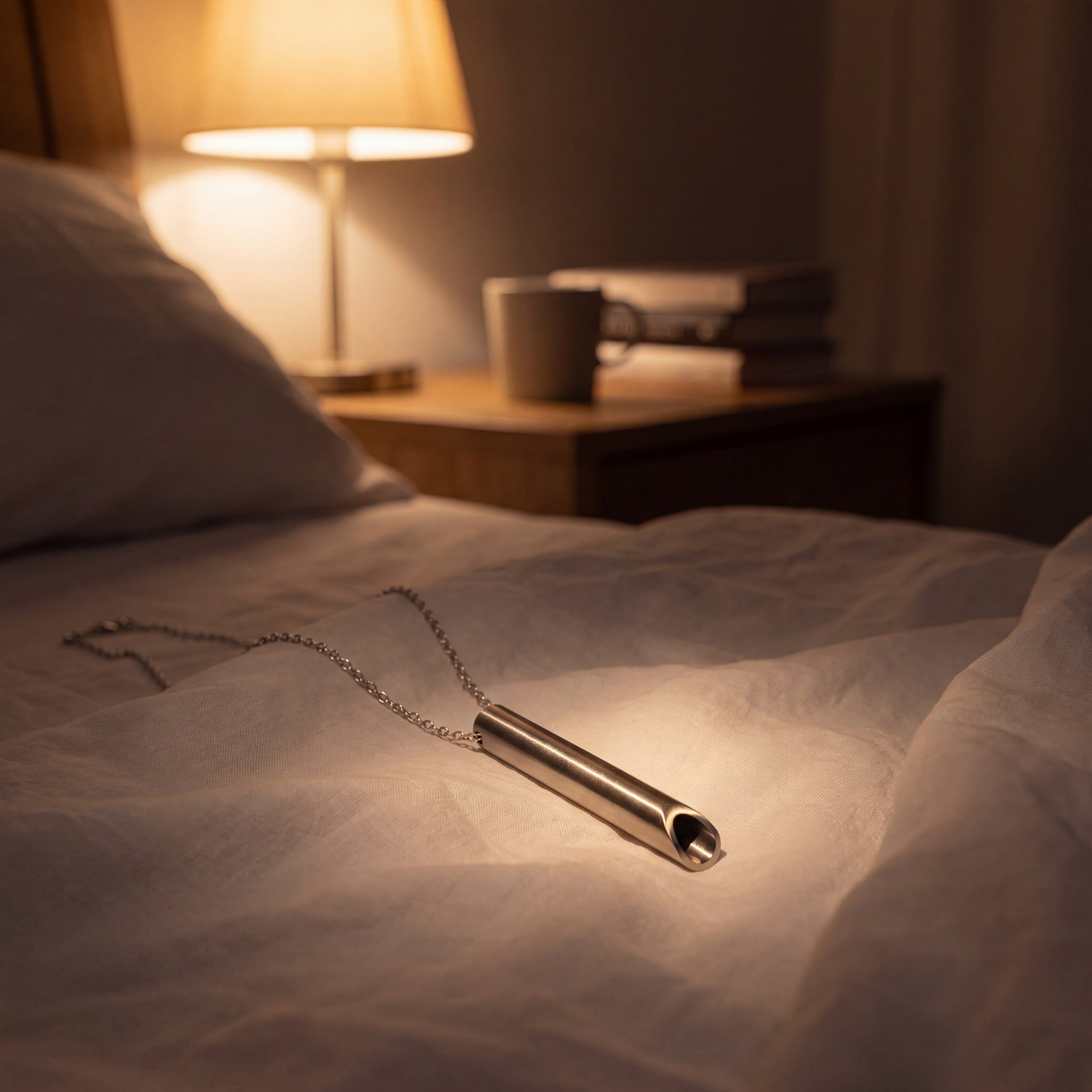
- Calibrated breathing pendant
- Free guided breathwork course
- 30-day money-back guarantee
- Whisper-quiet, wears as jewelry
Free shipping · Secure checkout
You already know how to breathe. This just makes sure it happens when it counts.
Wear Chime in your actual hard moments for 30 days. If it doesn't earn its place, we'll refund you in full — no need to send anything back.
Choose your Chime